

Every large company I know has one. It never shows up in the annual report, and nobody puts it on a slide. It is the place where good pilots go after the celebration: the pilot graveyard.
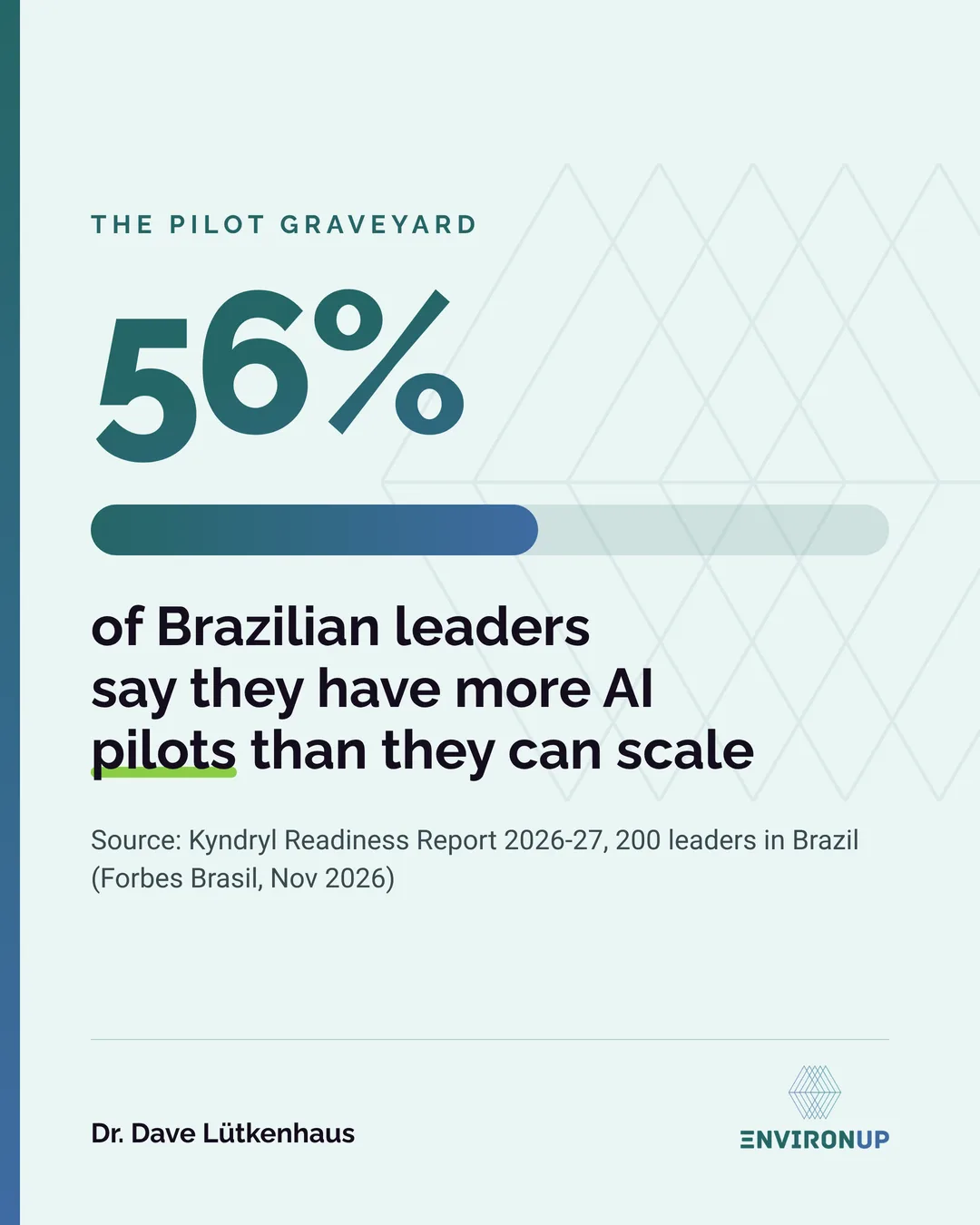
The numbers suggest it is getting crowded. In Brazil, 56% of the leaders surveyed by Kyndryl say they have more AI pilots than they can scale[1]. Globally, ISG found that only 31% of enterprises deploying AI had brought at least one of their three most-funded use cases into production[2]. And McKinsey's State of AI 2026 shows that 37% of companies attribute any EBIT impact to AI, roughly the same share as a year earlier, while only about 6% qualify as high performers[3].
So the question I keep asking leadership teams is a simple one. If so many pilots work, why do so few of them change the business?
A pilot answers the easy question
A pilot is designed to answer one question: does it work? Most of the time, the answer is yes. The technology performs, the data looks good, the team presents with pride, and everyone agrees it is promising.
Then the harder questions arrive, and they are organizational. Who owns this after the pilot? Whose budget pays for it next year? Which process has to change, and who agrees to change it?
These questions rarely have an owner on the day the pilot is approved. So the pilot waits. And a pilot that waits long enough quietly moves to the graveyard, still marked as a success in somebody's quarterly review.
Three ways a good pilot dies
A good idea leading to a great pilot can still die in good organizations. Here are a few ways this typically happens:
The orphaned success. The pilot team moves on to the next exciting project, and the business unit that should run the solution never asked for it in the first place. The result is excellent and belongs to nobody.
The budget calendar. The results arrive in September. The budget for next year closed in July. By the time the next cycle opens, the sponsor has changed roles and the momentum is gone.
The measurement gap. Research by MIT Sloan Management Review Brasil found that 86% of companies do not measure how much they spend on AI, and 88% do not know the financial return[4]. Without those two numbers, the decision to scale becomes a matter of opinion, and opinion loses to the next urgent priority every single time.
I have watched all three during my career, in large companies with talented teams and generous budgets. The technology was almost never the reason a pilot stopped.
What changes when you design for scale
I know it is never easy to define what needs to change without a full context. But typically, the companies that turn pilots into scalable results tend to do, in my experience, a few unglamorous things before the pilot even starts, including:
- They name the owner of the scale-up on day one. The pilot charter says who will run the solution in twelve months, and where the money comes from if it works.
- They test the handover, not only the technology. The pilot measures the cost at volume, the process change, and the people who will have to work differently.
- They close pilots on purpose. A graveyard with clear funerals is healthier than a waiting room full of "promising" projects. Every pilot ends with a decision: scale, redesign, or stop.
- They count what reached the business. The scorecard tracks scale-ups per year and value delivered, rather than pilots launched.
A pilot proves the idea. Scale proves the organization.
The question for your next steering committee
Before approving the next pilot, try asking three questions in the room:
- If this works, who will run it in twelve months?
- With which budget?
- And which process will we switch off to make space for it?
If nobody can answer, maybe the pilot is ready and the organization is still catching up.
How many successful pilots in your company are still waiting for an owner?